News and information from the New Orleans area
Posts tagged Carnival
Chicago Tribune claims best Mardi Gras parade in LA is in Baton Rouge!!
017 years
By Josh Noel, Tribune Newspapers January 17, 2010
BATON ROUGE, La. — The day starts about 7 a.m. and innocently enough: just one little beer.
BATON ROUGE, La. — The day starts about 7 a.m. and innocently enough: just one little beer.
It’s February and a little chilly — not too chilly for an Abita seasonal Mardi Gras Bock beer — and the streets have been closed to traffic. Locals are emerging from their homes, usually in the day’s signature pink, to wander, drink, smile, laugh and travel between early-morning parties. The visitors will be here soon. Many are already tailgating in nearby parking lots.
Gumbo and jambalaya won’t be ready for hours. Right now, it’s bloody marys, Cajun-spiced eggs and king cake, that deliciously gooey circular pastry in which a small baby figurine has been baked. Beads have yet to fly, but they will. It is the Saturday before Fat Tuesday, and 80 miles north of New Orleans, the best parade in the state is about to happen.
The Spanish Town Mardi Gras Parade is named for the neighborhood where it starts: Spanish Town, a patch of narrow tree-shaded streets and the traditional home of artists, boozers, cross-dressers and any free spirit in this conservative town. It is the city’s oldest and most eclectic neighborhood, appropriately listed on the National Register of Historic Places. The parade begins on its main artery, Spanish Town Road, before heading into Baton Rouge’s downtown of midrise office buildings.
I’ve seen New Orleans parades, small-town parades and rural horseback parades, and Spanish Town’s is the perfect amalgamation: rocking like New Orleans, intimate like a small town, with a dash of the country’s carefree calamity. Remember your birthday as a kid? The glory? The excitement? The knowledge that for one itty-bitty day, no one was more special than you? That’s what the Spanish Town parade feels like. Except that on Saturday, it’s everyone’s birthday. No, it’s not New Orleans, but that’s part of the raunchy, beer-soaked fun. Spanish Town Mardi Gras is tightly packed and joyfully unhinged without the expectation of being New Orleans.
By 10:30 a.m. breakfast is finished and houses start opening their doors, releasing the smell of gumbo. More R-rated costumes arrive, more beers are opened, and a 300-pound man dressed as the Octomom exchanges warm greetings with a uniformed cop. Turns out that 300-pound man was once a higher up in the governor’s office. In the costumes, the floats, even the theme of the parade, you learn that nothing is sacred, particularly power and politics. Months after Hurricane Katrina devastated Louisiana, the 2006 theme was “FEMAture Evacuation.”
The Spanish Town parade starts rolling at noon sharp, led by the grand marshal and, in recent years, the motorcycle-riding Baton Rouge police chief, who gladly poses for photos with drunken revelers.
The floats start inching by, and hands fly into the air. In pursuit of beads, women shake what God gave them. So do men. The roar is steady, cacophonous and endless. People load themselves with beads, load their neighbors, load their friends. Despite beer and homemade drinks aplenty, things don’t get out of hand. Everyone is a friend here.
Time stands so still that it’s hard to say how long the parade lasts. Maybe 90 minutes. Like most, it ends with an inglorious thud, street sweepers trailing the last float but doing little good against the quilt of beads. Beads are everywhere. In bushes, in trees, on power lines, and kids invariably try to shake them loose while adults wobble around them.
Then the house parties start again. Bands play in front yards and backyards. Gumbo and jambalaya steam in cast iron pots, and beer is everywhere. The partying goes on like this until about 5 p.m., when everyone starts hitting the wall. At 6 p.m. you’re done. The wobbliest are still trying to find which house they left their coat under, and everyone else goes home.
For the first time since being a kid, going to sleep at 7 p.m. doesn’t seem so bad. Make that for the first time since the last Spanish Town Mardi Gras. And, Lord willing, it will happen next year too.
State police will be in New Orleans for Mardi Gras
017 years
 WWL-TV Posted on January 15, 2010 at 9:44 AM
Updated Friday, Jan 15 at 11:01 A
BATON ROUGE, La. (AP) — Budget cuts will not keep the Louisiana State Police from beefing up protection in New Orleans during Mardi Grass.
State Police Superintendent Col. Michael Edmonson said on Thursday that he is taking steps to hold down overtime so that 118 troopers can be freed up to spend Carnival in New Orleans.
Edmonson says the plan he and New Orleans Police Chief Warren Riley have worked out will have uniformed officers mostly in the French Quarter and Central Business District. He says that will provide a solid presence in that area.
Edmonson says it also frees up NOPD officers for other areas.

2nd Annual Pussyfooters Blush Ball
017 years
The Second Annual Blush Ball, Mardi Gras kickoff celebration with the Pussyfooters Marching club and service organization was an event not to be missed! Blaine Kern’s Mardi Gras World (Westbank) was the perfect location for a Mardi Gras Party. The featured artists were Big Sam’s Funky Nation, DJ Soul Sister, the Mardi Gras Indians, the 610 Stompers, and the Pussyfooters.
This was a party with a purpose- a portion of proceeds went to support the Metropolitan Center for Women and Children. Visit metrobatteredwomen.com for more info. Metro provides victims of abuse with a crisis line, counseling and legal advocacy, and shelter services throughout the Greater New Orleans area.

Pussyfooters line up before stage routine
Here’s a photo of my friend Jack underneath the Bacchusaurus

Jack underneath Bacchusaurus
FLAMBEAUX
017 years
flambeaux lighting 2009
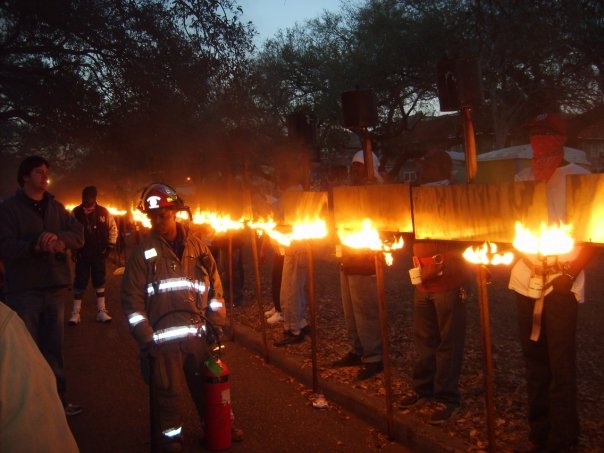
Illumination, so important to every night parade, has undergone many changes since Comus first introduced torches in their 1857 parade. Today, fiber optics, neon, and powerful Las Vegas style ‘running lights’ are growing increasing sophisticated but the old fiery flambeaux, with their golden glow, are much more appealing. Flambeaux means ‘torch’ in French.
The Richardson family first built and used flambeaux in New Orleans over one hundred years ago, although no patent was obtained until the 1930s. Momus was the first krewe to use the new flambeau in the 1870s, but they never owned their own- just rented them from other krewes.
Prior to the Richardson’s flambeaux, the krewes used hand torches, made from pine tar rags on wooden staves. Comus and Proteus first purchased the all metal flambeaux. Each club bought 400 devices, an order that has sufficed to this day. The two share a den, so all the flambeaux are now stored together. The earliest flambeau carriers were slaves and free men of color. The parade spectators would throw coins to the carriers, a tradition that continues today.
Bacchus innovated a new version of the flambeaux operating on natural gas. They burn cleaner and the units don’t suffer from the leakage problem the older liquid fuel models have. Endymion has become a big user of these newer flambeaux.
Barry Donahue is a flambeaux coordinator who hires torch carriers to help light parade routs for 3 Carnival krewes. “I need about 200 people and I’m just one (recruiter).”
Donahue, who says he has been organizing flambeaux crews for more than 20 years, said roughly half of his original labor crew has not returned since Hurricane Katrina flooded the city in 2005.
He has placed help wanted ads for “$$flambeaux carriers$$” in the Times-Picayune newspaper for at least a week with his phone number (504) 250-4462.
“In the past 6 or 7 years, we have been getting some college students,” he said. “It would be a great thing for a fraternity.”
Flambeaux organizers are not alone in the hunt for itinerant workers during the 12-day Carnival season.
Cascade Stables at Audubon Park has been advertising for “horse walkers” for several Carnival parades. See their Web site at http://www.cascadestables.net. Efforts to reach a spokesperson by phone were unsuccessful Tuesday.
Donahue says he pays flambeaux carriers about $55 per parade. However, the traditional “tips” thrown by parade spectators can swell a carrier’s pockets by an additional $300 to $600 a night, he said.
Many scoop up wads of cash.
“They don’t bother with coins anymore,” Donahue says of the itinerant workers.
Wearing a white, hooded cloak known as a “domino,” the flambeau carrier holds a rack of fuel and flame overhead like a flagpole — aided by a special belt.
A little showmanship often means more tips. So parade-goers are likely to see flambeaux carriers spinning their flaming cargo overhead, especially if there is a marching band nearby.
King Cakes, King Cakes, more King Cakes
017 years
I remember when I moved to NOLA, only plain King Cakes were sold in a few bakeries, especially McKenzie’s Bakeries around town. No groceries sold them. All King Cakes were plain. These were the dark ages of King Cakes. A number of years later, McKenzie’s introduced the first filled King Cakes, and there was no looking back. Now, every grocery and bakery in town wouldn’t consider not selling King Cakes- they bring in shoppers. New Orleanians cannot get enough King Cakes! We live in the enlightened age of King Cakes, with a zillion flavors available to anyone in the world with an internet connection.

To show just how far filled King Cakes have come, here’s the list from Rouse’s Supermarkets current circular of the various fillings and flavors they sell:
Almond
Apple
Apple Cream Cheese
Bavarian Cream
Blueberry
Blueberry Cream Cheese
Caramel
Chocolate
Coconut
Cookies & Cream
Cream Cheese
Heavenly Hash
Lemon
Pecan
Pina Colada
Pineapple
Praline
Raspberry
Strawberry
Strawberry Cream Cheese
That’s a lot of flavors, and even more exist. Pick a flavor, and someone makes and sells that flavored King Cake!
I conducted an unscientific poll among my facebook, twitter, myspace, and nola.com Mardi Gras forum ‘friends’. The overwhelming choice of most for the best King Cake in the metro area is Haydel’s Bakery first and Randazzo’s second.
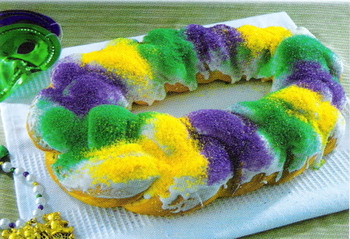
In the Christian faith, the coming of the wise men bearing gifts to the Christ Child is celebrated twelve days after Christmas. This is known as the Feast of the Epiphany or Little Christmas on the Twelfth Night. This is a time of celebration, exchanging gifts and feasting. Today, the tradition continues as people all over the world gather for festive Twelfth Night celebrations. A popular custom was and still is the baking of a special cake in honor of the three kings called a King’s Cake. In these early cakes, a pea, coin or bean was hidden inside the cake. Now, King Cakes contain a tiny plastic ‘baby’. The person whose piece contains the baby has to throw the next King Cake party. King Cake parties are enjoyed by the young and old all over the region and the world via the internet.