News and information from the New Orleans area
Carnival
FLAMBEAUX
017 years
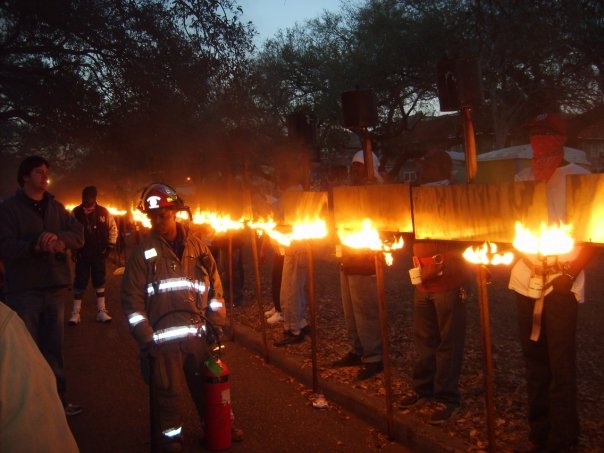
flambeaux lighting 2009
Illumination, so important to every night parade, has undergone many changes since Comus first introduced torches in their 1857 parade. Today, fiber optics, neon, and powerful Las Vegas style ‘running lights’ are growing increasing sophisticated but the old fiery flambeaux, with their golden glow, are much more appealing. Flambeaux means ‘torch’ in French.
The Richardson family first built and used flambeaux in New Orleans over one hundred years ago, although no patent was obtained until the 1930s. Momus was the first krewe to use the new flambeau in the 1870s, but they never owned their own- just rented them from other krewes.
Prior to the Richardson’s flambeaux, the krewes used hand torches, made from pine tar rags on wooden staves. Comus and Proteus first purchased the all metal flambeaux. Each club bought 400 devices, an order that has sufficed to this day. The two share a den, so all the flambeaux are now stored together. The earliest flambeau carriers were slaves and free men of color. The parade spectators would throw coins to the carriers, a tradition that continues today.
Bacchus innovated a new version of the flambeaux operating on natural gas. They burn cleaner and the units don’t suffer from the leakage problem the older liquid fuel models have. Endymion has become a big user of these newer flambeaux.
Barry Donahue is a flambeaux coordinator who hires torch carriers to help light parade routs for 3 Carnival krewes. “I need about 200 people and I’m just one (recruiter).”
Donahue, who says he has been organizing flambeaux crews for more than 20 years, said roughly half of his original labor crew has not returned since Hurricane Katrina flooded the city in 2005.
He has placed help wanted ads for “$$flambeaux carriers$$” in the Times-Picayune newspaper for at least a week with his phone number (504) 250-4462.
“In the past 6 or 7 years, we have been getting some college students,” he said. “It would be a great thing for a fraternity.”
Flambeaux organizers are not alone in the hunt for itinerant workers during the 12-day Carnival season.
Cascade Stables at Audubon Park has been advertising for “horse walkers” for several Carnival parades. See their Web site at http://www.cascadestables.net. Efforts to reach a spokesperson by phone were unsuccessful Tuesday.
Donahue says he pays flambeaux carriers about $55 per parade. However, the traditional “tips” thrown by parade spectators can swell a carrier’s pockets by an additional $300 to $600 a night, he said.
Many scoop up wads of cash.
“They don’t bother with coins anymore,” Donahue says of the itinerant workers.
Wearing a white, hooded cloak known as a “domino,” the flambeau carrier holds a rack of fuel and flame overhead like a flagpole — aided by a special belt.
A little showmanship often means more tips. So parade-goers are likely to see flambeaux carriers spinning their flaming cargo overhead, especially if there is a marching band nearby.
Krewe du Vieux 2010
017 years
Krewe du Vieux 2010
Krewe du Vieux is Fired Up!!
Krewe Website: www.kreweduvieux.org
Parade Rolls January 30th, 2010 6:30 pm
August 5, 2009 FIRE AT THE KREWE DU VIEUX DEN!! Here’s my post that day:
Got this from one of the New Orleans bloggers: Just got home. Fire trucks everywhere. KdV Den fire. Seeds, Lewd and TOKIN floats are toast. Fire out now. Looked in for a sec before being shooed away. Front right corner of the den is just pretty much gone–I mean the stuff that was in that corner. Wanted to take pics but wasn’t allowed. Will try to get over there again. No word on the cause.
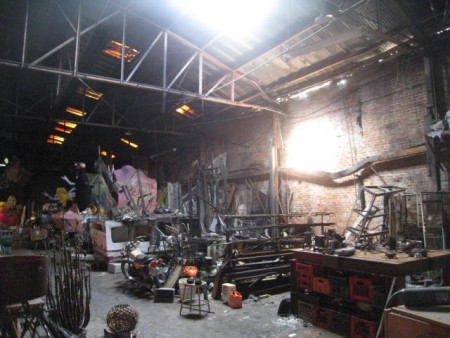
KdV fire damaged area
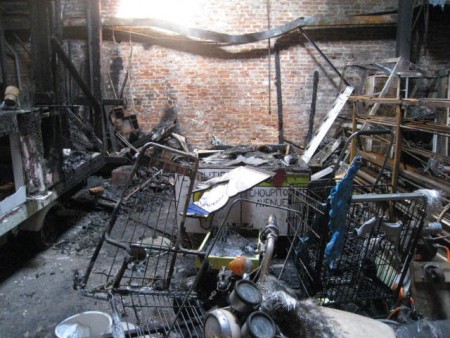
KdV Seeds after den fire
January 12, 2010- I’m happy to report the damaged floats are repaired, and the krewe is putting the finishing touches on all floats as they prepare to roll in a couple of weeks.
No parade heralds the start of the Orleans Parish Parade Season more than KdV. I’m an escort in the parade, as I was last year. That means I’m float and krewe security while the parade rolls. I get to photo the krewe and the den before the parade, interview key krewe leaders.
Before there was KdV, there was its predecessor, Krewe of Clones. Clones grew directly out of the Contemporary Arts Center. The CAC ran the parade, and the parade staging area was the CAC parking lot on Camp Street. It was an arty, satirical parade from the start. I still have an original Krewe of Clones T shirt with the theme Barbie & Ken go to the World’s Fair.
After watching the parade one year in front of the CAC, we noticed the CAC Parade Marshall was drinking heavily over the couple of hours it took the parade to leave the staging parking lot.
The next year, we hatched a plan to crash the parade with our own float, taking advantage of the Marshall’s inebriation. We decorated our VW van into an elephant float by dying some sheets gray, and constructing a paper mache trunk, ears, and tail.
The night of the parade, we drove our float into position next to the CAC. When the parade was almost out of the staging area, we took advantage of the loose formation conditions, and drove our float straight onto the route. The Parade Marshall waved us on. For the next few years, we morphed that old van into other animals, and continued to crash the parade until the Marshall ‘retired’.
As stated, I’m in the Krewe of Underwear. Here, straight from the Krewe’s of Underwear website is the rest of the story:
The Krewe of Underwear was founded in [the early 1980s] as a sub-krewe of the storied Krewe of Clones. This wild, satirical Carnival parade, which first marched in 1978, was based out of New Orleans’ Contemporary Arts Center.
- Unfortunately, in 1986, infighting among the Krewe/CAC leadership, combined with pressures from the City due to the parade occurring the night before the Super Bowl was to be played in New Orleans, caused the untimely demise of the Krewe of Clones. Not wishing to be denied a good time or any excuse for wild excess, the Krewe of Underwear along with another Clones sub-krewe, the Krewe of Mama Roux, held a “Clone Funeral”. An anatomically correct (and erect) clone was created and placed on a funeral cart, and a short march to a party site was planned.
At the last minute, the individual most responsible for the entire problem got word of the plans, and called the police on the unauthorized march. Informed by New Orleans’ finest that they could not march in the street, since that would block traffic, the Underwearians and their fellow mourners marched on the sidewalk, while eleven police cars rolled along next to them, blocking the street far more effectively than the marchers ever could have.
That same year, two other Clones sub-krewes, the Seeds of Decline and the Krewe of C.R.U.D.E., held their own informal march on Mardi Gras itself, in the French Quarter. After Carnival was over that year, the two groups got together, established an official parade date (three Saturdays before Mardi Gras, the old Clones date), and received permission to march in the French Quarter. Thus was born the Krewe du Vieux Carre (the old, French name for the Quarter), now shortened to Krewe du Vieux. The first Captain of Krewe du Vieux was Underwear’s own Craig “Spoons” Johnson.
As a founding sub-krewe of Krewe du Vieux, Underwear is a leader in theme and float creativity, satire, obscenity, and general crazed celebration. Instantly recognizable by the long, red union suits that are the basis of Underwear apparel (not to mention the only underwear ever worn by most krewe members), the Krewe of Underwear takes on political follies, social norms and a large amount of alcohol every year in the best parade in New Orleans, the Krewe du Vieux.
Agreement Reached Between N.O. Mayor, Council Members Over Budget Restores Parade Reviewing Stands
017 years
by Mike Hoss / Eyewitness News
Posted on January 5, 2010 at 4:41 PM
Updated Tuesday, Jan 5 at 10:04 PM
NEW ORLEANS — An agreement has been reached between Mayor Ray Nagin and members of the New Orleans City Council to restore some of the funding that had been cut for several city services.
Negotiations have been ongoing on this issue since last month, with officials trying to reach a compromise between the two budgets: the mayor’s budget and the council’s budget. Significant cuts went into effect this week, but around 4:30 p.m. Tuesday, all the parties said they had reached an agreement on the 2010 budget with many of the services restored.
Among the services that were restored include blight hearings, as the city tries to get some of the blighted properties back into the market; money for the District Attorney’s Office; juvenile and municipal criminal courts; emergency services; and the parade viewing stands at Gallier Hall for Mardi Gras now has the funding for the city to put them up and take them down.
“I’m happy to say that through our collective discussions with the mayor, and Dr. Hatfield and councilmember Morrell as budget chair, we have restored a number of the cuts that were made that the public wants restored,” Fielkow said.
Councilwoman Cynthia Hedge-Morrell said while they could not restore everything, that’s just the nature of the budget process. “Again, I want to reiterate what our council president said, and what Dr. Hatfield and what the mayor agreed to: we looked at critical issues that had to be restored,” she said.
A four-day work week at City Hall remains in effect. Friday it will stay closed, and its new schedule will stay from Monday to Thursday from 8 a.m. to 6 p.m.
“Just keep in mind that even though we are only open four days a week, our employees are working 35 hours a week,” said Dr. Brenda Hatfield, chief administrative officer. “And so actually the day is extended until 6 o’clock for services, and some people in the community like that.”
So where does the new money come from? It comes from new revenue projections. The mayor had his budget, with the revenue projected at about $462 million, and the City Council was a little lower at $455 million. The compromise for the new budget for 2010 is somewhere around $460 million.
The issue now goes to the City Council on Thursday. They must first vote unanimously to put it on as an emergency agenda item, and then it must be a simple majority vote of the council to pass, once again, the 2010 budget.
My Little Mardi Gras Blog Merges with Carnivalneworleans.com
017 years
Holy Moly!! My little Mardi Gras blog, started as a labor of love to express my love of Carnival, has joined the ranks of the big Mardi Gras web players. Icorp.net’s Carnivalneworleans.com had 200 million visitors over the last decade. Google ‘Carnival New Orleans’ or ‘New Orleans Carnival’, and carnivalneworleans.com comes up a least twice in the top 10 rankings. That brings the Mardi Gras loving hordes to carnivalneworleans.com every season.
Carnivalneworleans.com has always been a static site, featuring an elaborate History of Mardi Gras and loads of photos from Mardi Gras past. The photos cover the Mardi Gras spectrum from the bawdy French Quarter to the Barkus dog parade, also in the French Quarter. The content has successfully drawn hordes of visitors, as it is the kind of information that any Mardi Gras enthusiast can use and enjoy.
2009 New Orleans Mardi Gras Wrap Up
318 years
Carnival 2009 was noteworthy in some respects. For example, the only cold weather of the season occurred during the second Carnival weekend, not the first weekend. 2009 was the 100th anniversary of the Zulu organization, and was also the 50th anniversary of the Mardi Gras Doubloon, an anodized aluminum ‘coin’ that had the krewe logo on one side and the parade theme on the other. Rex was the first krewe to throw doubloons 50 years ago. The doubloon also changed the economics of krewes- it was the first throw that the krewe could sell to its members for a small profit, thereby adding a important revenue source for all krewes. 2009 was the year that electric light up beads became almost commonplace.
ORLEANS PARISH PARADE SUMMARY
Pre-Season:
Krewe du Vieux: KdV was big, brash, and more biting than anyone else (rated M for mature) in its satire. The floats are mule drawn, and they have more brass bands than anyone else- seventeen in 2009. They are the only krewe to march in the French Quarter and Faubourg Marigny. KdV is the only adult themed krewe to march down the streets of New Orleans. I love KdV but I’m partial because I am in KdV.
First Weekend:
Oshun, Pygmalion and Ponchartain are small parades, but the first of the season to travel down St. Charles Avenue, and therefore very very welcome. Ponchartrain used to parade in the Lakeview area. I’ve always loved their giant crawfish float. Sparta looked different this year. They had bigger floats and didn’t look as historic as in the past. Sparta is the first krewe each season to use traditional kerosene fueled flambeaux. Pegasus is an open krewe that allows the public to join the krewe, ride in the parade, and attend krewe events and parties. Carrollton and King Arthur on the first Sunday are the only parades down St. Charles Avenue that day making it a very short weekend parade day.
Weekday Parades:
Babylon is the fully traditional parade of the season, and they were celebrating their 70th anniversary in 2009. Babylon has the look and feel of an old fashioned parade from a century ago. Many of their paper mache floats ride on wood wagon chassis and wooden wagon wheels and they utilize the original flambeaux made for Rex and Comus a long time ago.
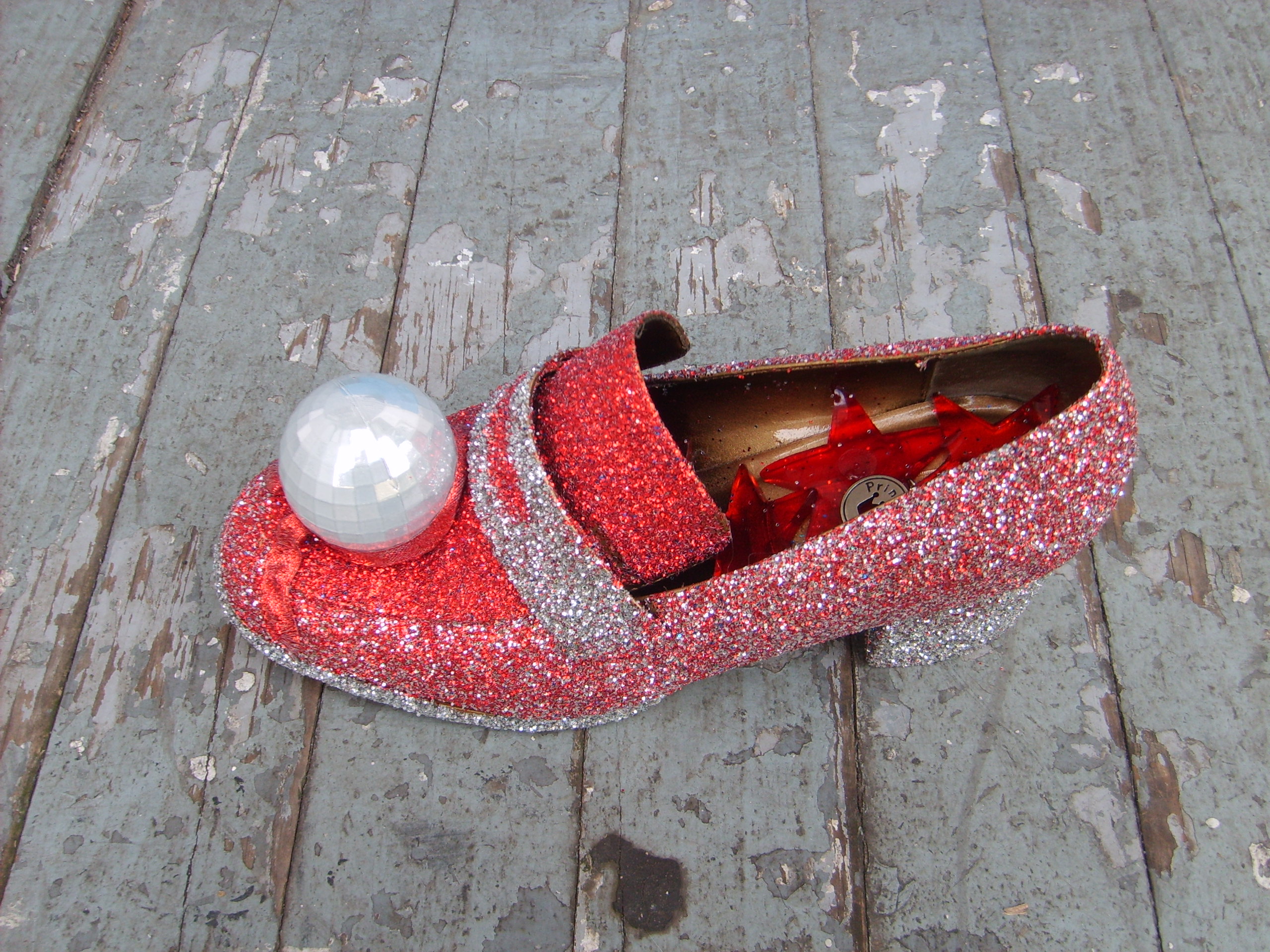
Muses, an all-female krewe, was simply the best parade of the season for a number of reasons:their huge advantage in the type and variety of their throws, their emphasis on the woman’s shoe as krewe emblem, and their far out marching groups like the Rolling Elvi, the Camel Toed Lady Steppers, Pussyfooters, and Bearded Oysters. A great article on the groups can be found in Where Y’at Magazine’s web site here . Muses has established their hand decorated woman’s shoe throw on a level that approaches the Zulu coconut.
Chaos utilized a relatively new kerosene flambeaux that are not part of the original set made for the old krewes in the late 1800s. The older krewes wouldn’t allow newer krewes to use their original flambeaux, so an ingenious and crafty krewe Captain studied the original flambeaux and created very close copies that work similarly but apparently don’t violate any patent. Chaos was the first parade this season whose floats were made by Royal Artists, who make the some of the best traditional paper mache floats in all of Mardi Gras. Check out Royal Artists’ web site here . Hermes was the first parade on a three parade night, and the floats were made by Royal Artists, giving the parade a traditional paper mache look. Hermes utilizes the older flambeaux. D’Etat goes all out to promote their parade, putting up two different fliers on poles throughout the parade route. D’Etat was one of the very first krewes to toss large numbers of light up beads, one of the biggest trends in Carnival throws. E’tat had a really good looking 3-D krewe cup, the only 3-D cup that I saw all parade season. The 3-D cup uses lenticular technology. Morpheus also used the longer route, following D’Etat. Morpheus is only 8 years old, but they have a traditional look to them. The painting on Morpheus’ floats was different than the other krewes, and I found the style simple but pleasing.
2nd Weekend Parades:
Iris is the oldest of the two all-female parading krewes, Muses being the other. Iris favors children with their throws. Tucks was formed by Loyola college students a few decades ago, and have kept their irreverent attitude. Their unique toilet float has been updated into the King’s float, keeping the porcelain fixture intact.
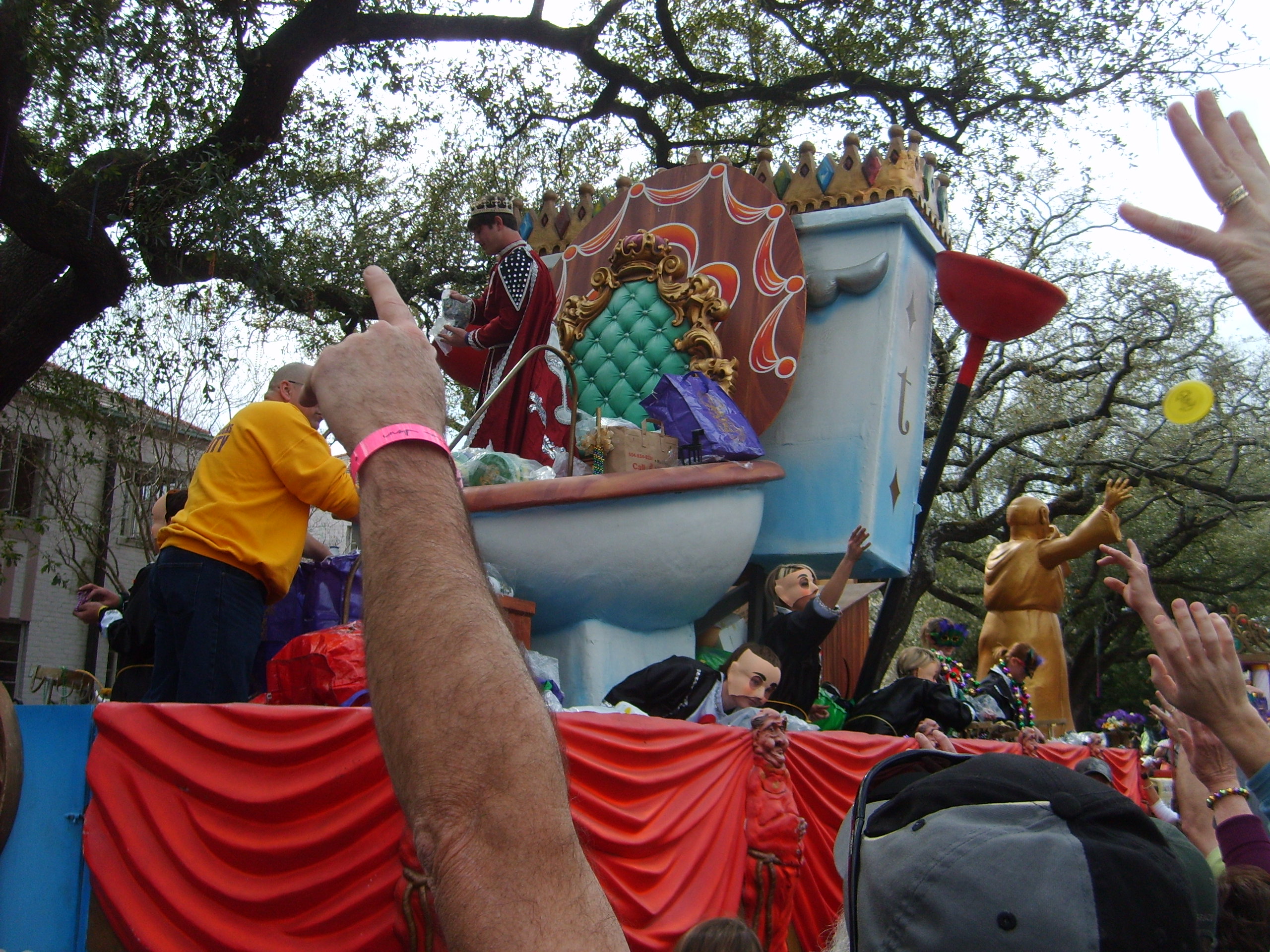
One of the reasons I love Tucks is because I had my own float in Tucks for three years, at a time when Tucks solicited for floats to augment their parade.
Endymion is the biggest of all ‘super krewes’ with over 2,000 riders. Kid Rock was their celebrity king, and before the parade, at the big Endymion block party, Kid Rock reprised his big summer hit, Sweet Home Alabama before a huge crowd. Endymion has the most riders, the biggest floats, the most throws, terrific bands, and the biggest crowds. Endymion began as a neighborhood parade in 1966, and morphed into a super krewe in 1974. They utilize a third type of flambeaux, a propane version.The original flambeaux design burns kerosene, and the system has always leaked. The kerosene is stored in a tank above the head of the flambeaux and gravity carries it down to the burners. I’m not sure who owns these.Okeanos celebrated their 60th anniversary this year. New this year, several krewes that historically started on Napoleon Avenue began their routes at Jefferson and Magazine Streets. Okeanos was the first to try out the route addition. Mid-City was the first parade to use colored foil to decorate their floats, and when the sun is shining, Mid-City’s floats look superlative. Mid-City has an old tradition, the “Greatest Bands in Dixie” contest for the bands that participate in the parade.
Thoth has their own extra long route uptown, as they parade past hospitals and retirement homes. Thoth looked better than usual. In the past they rented their floats from Hermes, and many times, their floats didn’t match the float titles. This year, they had better looking floats that weren’t Hermes.

Bacchus, the original super krewe, was formed in 1968 as a super krewe. To our eyes, Bacchus looked a little smaller in 2009. Bacchus was the first krewe to have a celebrity king each year, and they originated the huge super floats that contain dozens and dozens of riders. Today, there are 4 super krewes in New Orleans- Bacchus, Endymion, Rex, and Orpheus. On the West Bank, Alla qualifies as a super krewe, and in Metairie, Caesar does.
Monday Night Parades:
Proteus began parading in 1881. They use the old wooden wagon chassis and wagon wheels, and the traditional flambeaux they started with over a century ago. I caught a light up seahorse medallion at the parade this year. Proteus is a good looking, traditional paper mache parade built by Royal Artists. The only two parading krewes from the 1800s now are Proteus and Rex. Comus, who began parading in 1857, and Momus, who started in 1872, stopped parading in 1992 after the New Orleans City Council, led by Dorothy Mae Taylor, passed an anti-discrimination ordinance. Proteus stopped parading at this time, but resumed parading in their old Monday night slot in 2000. Orpheus, the super krewe founded by singer/actor Harry Connick, Jr., looked a little less super in 2009. For one thing, after the first few floats, the bands ran out. Super Krewes find enough bands no matter what. While many of their floats were giant, gorgeous creations, many others were ordinary.
Mardi Gras Day Parades:
Zulu celebrated their 100th anniversary in 2009, and to celebrate, their parade, perennially late, was actually early! That is a really big deal for Zulu. I received 5 coconuts after 1/2 of Zulu, which is more than I’ve ever received in over 30 Zulu parades. Today’s Zulu coconuts are improved, 4 of the 5 coconuts I received had the milk and meat removed. If you leave the milk and meat, the coconut often rots. Zulu led off their parade with the Edna Karr High School Band, which was a big switch. Historically, Karr hasn’t been known for leading off Zulu, but in this post-Katrina New Orleans, anything can happen. Rex, King of Carnival, was the first krewe to throw doubloons 50 years ago. Legend has it that Alvin Sharpe, inventor of the Mardi Gras Doubloon, proved the doubloon were safe enough to throw from the floats by tossing a handful at the Rex Captain’s face. When he was unhurt, the doubloon was launched into Mardi Gras throw history. The organization that puts on the Rex parade in called the School of Design. The line of throws thrown by Rex increased in recent years. Historically, Rex threw one type of medallion. This year, they had numerous varieties of logo beads, and two sizes of plush Boeuf Gras. In 2009, Rex didn’t look quite as royal as the King of Carnival should. They too suffered from a bad float/band ratio. Yes, it’s the end of Carnival, but Rex has surmounted this problem before, and I’m surprised and disappointed that they couldn’t obtain even close to enough bands. On St. Charles Avenue a few blocks from Napoleon Avenue, the crowd was lighter than usual. The crowd over the weekend on Bacchus Sunday was noticeably bigger. Yet there is no parade like Rex. They alone have the Boeuf Gras and Jester floats. These floats, along with the Rex King’s float, are the symbols of Carnival in New Orleans the world over.