News and information from the New Orleans area
Posts tagged Carnival
Mardi Gras "Royalty" Reign Over Balls
018 years
by NewOrleansMusicMan
in Mardi Gras
The traditional Mardi Gras ball is venerable institution in Carnival society, often following a stylized routine that began well over a century ago. For many years, the balls of older Krewes took place in the Municipal Auditorium. Since Hurricane Katrina, the Morris F.X. Jeff, Sr. Municipal Auditorium still festers un-renovated, even though next door, the Mahalia Jackson Theater of the Performing Arts has been restored beautifully. For 2009, Rex will hold its ball in the Sheraton Hotel on Canal Street in the French Quarter.
Most balls are slated to begin at 9 pm and valets often with years of experience, help the riders with their change of clothes. Many Krewes have to hurry because there is only a short period of time between the end of the parade and the start of the ball.
Receiving an invitation to a Krewe ball, especially an old line club like Rex or Comus, is a social coup of major proportions, as there are only a very limited number of invitations and attendance is by invitation only. There are two levels of guests, those whose invitations specifies balcony seating and those who are spectators only; those who have a “callout” card enclosed in their invitation have floor seating and are allowed to dance as they are “called out” by members of the Krewe. This procedure is rigidly set in tradition. As a Krewe member decides on a dance partner he whispers her name to a “committeeman” who then escorts the lady to the floor. A favor is customarily given to the lady by the Krewe member after the first dance.
The primary reason for holding a traditional ball, however, is not dancing. The highlight of the ball is the tableau; the auditorium is decorated, often lavishly, and the King and Queen are seated on the dais “reigning” over the proceedings. The court is then presented in an elaborate pageant. Drinking is not allowed on the floor of the tableau balls although refreshments are usually available backstage. The festivities are usually over by midnight.
Tradition is changing, somewhat, as newer Krewes have more interest in socializing and less in tableaux presentations. Dinner dances, potluck and cocktail parties have gained in popularity, and a few large Krewes such as Bacchus, Zulu, Orpheus, and Endymion stage huge extravaganzas with national entertainment. Even Rex has changed, allowing all guests onto the dance floor after a specified time.
The culmination of the traditional ball season is the meeting of Rex and Comus at midnight, an impressive fitting and fitting close to Carnival festivities. (more…)
Hail MUSES, Mardi Gras Throw Innovator
018 years
by NewOrleansMusicMan
in Mardi Gras
Throw innovation is only one of the games of Muses, the largest and baddest of all the woman’s krewes. In their prime in the mid 1980s, Shangri La in Chalmette was a mighty all-female krewe, with over 1,000 members. However, their membership declined since Katrina, and chose not to parade in 2009.
Muses began parading as an all-female krewe in 2001. Staci Rosenberg is founder and captain of Muses. In just eight short years, Muses is at the absolute top of the New Orleans krewes in terms of creativity and numbers of throws. No other krewe comes close to matching the depth and breadth of their throws. They also are one of the largest krewes in terms of membership, with 1,500 members.
Muse’s personalized throws from last year, 2008 (incomplete list): oversized logo powder puff, working lava lamp key chain, Muse comic book ( “SuperMuse”), full size decorated woman’s shoes, shoe medallion bracelets, roller skate medallions, Muses LED-Fan, Muses glitter stick-on fashion accessory, lighted shoe medallions, Muses Night Fever (parade theme), lighted medallion, plastic crystal lighted heart medallion, soft spear, headband, disco ball medallion, song spoofs and lyrics booklet, regular logo beads, and more. Here’s a link to a really cool U-Tube video we shot of a 2009 Muses LED-FAN throw Muses LED-Fan
No other krewe comes close to the number and variety of personalized throws that Muses throws. I’ve seen the short published list of new throws for 2009, and I’m sure it is very incomplete. Muses do not publish their full list before the parade.
R&B CARNIVAL MUSIC
018 years
Carnival music adds considerable excitement to the festivities. All the major activities of the Carnival season: parades, balls, and parties make heavy use of music.
Probably the most popular songs of Carnival, revived annually on jukeboxes, the internet, and across the radio dial, are Rhythm and Blues Carnival Tunes performed by Professor Longhair, Al Johnson, and the Hawketts (also Hawkettes).
Four songs are heard most often: The Hawketts’ Mardi Gras Mambo, Al Johnson’s Carnival Time, Professor Longhair’s Go To the Mardi Gras, and Earl King’s Big Chief Part 1 & 2 (as performed by Longhair).
Mardi Gras Mambo was a local hit for the Hawketts in 1954. It was the first recording experience for the group, which included lead vocalist and organist Art Neville. The majority of the band was still in high school. They received little money from the recording, but were established as a favorite local performing group because of it. Oddly, there was never another Hawketts recording.
Over the last couple of decades, Mardi Gras compilations have multiplied prodigiously. The first and best compilation remains Mardi Gras Records’ Mardi Gras in New Orleans. The track list follows:
1. Go to the Mardi Gras, Professor Longhair
2. Handa Wanda, Bo Dollis and Wild Magnolia Mardi Gras Indian Band
3. Carnival Time, Al Johnson
4. Big Chief Part 2, Professor Longhair
5. Street Parade, Earl King
6. Second Line Part 1, Stop Inc.
7. Mardi Gras Mambo, the Hawketts
8. New Suit, the Wild Magnolias
9. Big Chief, Part 2, Professor Longhair
10. (Big Chief like plenty of) Fire Water, The Wild Magnolias
11. Handa Wanda Part 2, Bo Dollis and Wild Magnolia Mardi Gras Band
12. Second Line Part 2, Stop, Inc.
No article on popular Carnival music could be complete without mention of the official song of Rex, If Ever I Cease to Love. This song, a waltz, is the favorite of much of the ball-going set, a position it has held for a very long time, as the tune was first performed at the very first Rex parade in 1872.
The song was selected because Alexis Romanoff Alexandrovitch, the Grand Duke of Russia, had seen Lydia Thompson sing it in New York in a burlesque show, Blue Beard, and was smitten by both the woman and the tune. The Duke’s decision to visit New Orleans during Carnival prompted the hasty organization of a gala daytime procession, which became Rex. In honor of the Russian guest, If Ever I Cease to Love was played often. The song was an instant success, and it has been the preeminent ball tune ever since.
CLYDESDALES!!
018 years
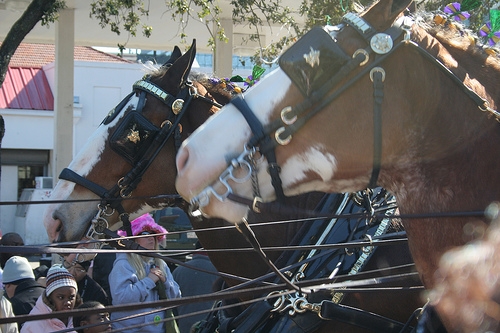
The Clydesdale team in action, courtesy Paul J. Murphy, 2007
Carnival in New Orleans wouldn’t be the same without the annual appearance of the famed Anheuser-Busch Clydesdale Horses. The eight horse hitch pulling the traditional Budweiser beer wagon will appear in seven parades in the New Orleans area: 2/13, Excalibur; 2/14, Ceasar; 2/15, Nemesis; 2/17-19, stable viewing; 2/20, D’Etat; 2/21, Endymion; 2/22, Bacchus; 2/24, Zulu.
The Clydesdale breed is a heavy draught (work) horse breed originating in Scotland and improved through crossbreeding with Flemish stallions. They were introduced into America as a draught horse used to pull a load.
In 1933, August A. Busch, Jr. introduced the first Clydesdale hitch to celebrate the end of Prohibition. Today, three eight-horse hitch teams travel the US, making more than 400 appearances annually.
The Clydesdales travel in style. Each eight-horse hitch is transported via caravan in three fifty by eight-foot custom designed vans with air cushion suspension, thick rubber flooring to ease the rigors of standing. Vent fans and insulation assure fresh air and comfortable temperatures. The caravan stops each 100 miles while traveling and at night to attend to the horses’ comfort.
Weighing in at slightly more than one ton, each gelding eats 25 pounds of pounds of beet pulp, crimped oats, bran, minerals, salt, and molasses daily, plus 55 pounds of hay.
In 1950, the first dalmatian appeared for the Newark Brewery Opening. They have been the official mascot ever since.
Grooming and dressing the Clydesdales is a massive undertaking. It takes an average of 45 minutes to wash a single horse. Braiding ribbons into the mane and tail takes another 20 minutes. Then into the black and brass $35,000 custom-made harness-ware. In all, it takes five hours of strenuous work to ready each animal to meet their public, and they sometimes make two appearances in a day.
In the New Orleans area, the Clydesdales are stabled at the local Budweiser Distributor:
Southern Eagle Sales & Service
5300 Blair Drive
Metairie, LA 70003
They always have a nice display set up and you can come out and pet them and meet the handlers who take care of them and travel with them. When I went to my local Rouses Grocery on Tchoupitoulas Street around noon today (February 17, 2009), there was a Bud Clydesdale horse doing public relations with one of the huge buses they travel around in. I didn’t have my camera with me, and my phone camera sucks.
To get WDSU Parade Tracker updates on your cell phone, text “follow parades” to 40404
018 years
by NewOrleansMusicMan
in Mardi Gras
Check out wdsu.com. They have gps units on the first and last floats of all the parades and text the info live via twitter to your phone. You can always know where the parades are while they are running and you are running after them. To get complete details how to turn this service on and off, go to: http://www.wdsu.com/mardigras/18640644/detail.html#parades